Mary Is Our Mother — and Our Little Sister, ‘Younger Than Sin’
Bernanos’ unforgettable phrase reveals a Marian mystery at the heart of salvation history — the innocence that preceded even the Fall.

If asked to identify a principle central to the practice of the Christian faith, where would you begin? Is there something out there that leaps right off the page, a statement of belief, of behavior, without which Christianity becomes, at best, indistinguishable from the usual bromides of secular uplift?
What about the principle of strength made perfect through weakness, of power and plenitude emerging precisely out of emptiness and exhaustion? The idea of glory and majesty, in other words, revealing themselves in the meek and humble of heart?
Only we mustn’t think of it as just another idea or concept, however compelling its ethical appeal, because the moment you do that you risk turning Christianity into an abstraction, and no one wants to sign on with an abstraction, much less suffer and die to keep an abstraction alive. If you must give it a name, call it a paradox, as in any seeming contradiction that turns out, startlingly enough, to be true. “Truth standing on her head to attract attention,” is how Chesterton once put it, of which the most stunning example is the dying God, whose infant hands “made the sun and the stars, yet were too small to reach the huge heads of the cattle. Upon this paradox,” insists Chesterton, “all the literature of our faith is founded.”
And when applied to us, it becomes the whole theme of the grain of wheat falling into the ground, so that in dying it may give life; the amazing mustard seed, whose future prospects exceed every possible expectation. How can anything so poor, so unprepossessing, be given a destiny beyond the stars? A destiny that not only defies death and dissolution, but paradoxically follows and even feeds upon them? As Heraclitus tells us, “The way up and the way down are one and the same way.”
And everything in the life of nature and grace testifies to this truth. There is nothing that will be made whole that hasn’t first been rent in two. The seed must break apart before it can become wheat. The soil must be broken open before it can produce a crop. The clouds must first part before the rains can fall. How else will the wheat grow in order to give us bread? And what is to be done with bread but to break it open to make a meal, especially that most important and necessary meal, the Holy Eucharist, the Great Feast of Faith, without which we shall go hungry forever?
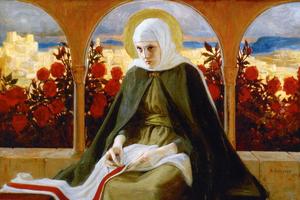
So, we mustn’t fear becoming a broken thing because that is how God will raise us up. He has had long experience, after all, with casting down the mighty from their thrones, so as to lift up the lowly. Go ask Our Lady, who, in her sheer openness to God, was filled with good things, while the rich were sent away empty. She who was, from the first moment of her existence, younger than sin, as Bernanos so beautifully describes her in that wonderful novel of his called The Diary of a Country Priest:
No one has ever lived, suffered or died in such simplicity. … For she was BORN without sin — in what amazing isolation! ... The Virgin was Innocence. Think what we must seem to her, we humans. Of course she hates sin, but after all she has never known it, that experience which the holiest saints have never lacked. … The eyes of Our Lady are the only real child-eyes that have ever been raised to our shame and sorrow…eyes of gentle pity, wondering sadness, and with something more in them, never yet known or expressed, something which makes her younger than sin, younger than the race from which she sprang, and though a mother, by grace, Mother of all grace, our little youngest sister.
What must it be like, I wonder, how differently would we live, were we to be that young? Chesterton says the moment you walk out of the Confessional, freshly shriven, you are five minutes old. And while most of us might wish to be that young, Mary was younger still. How does one account for that? What does that even mean?
It means she was the perfection of that poverty of spirit of which Christ speaks in his Sermon on the Mount, naming it the first of all the beatitudes. It means the Kingdom of God is hers, that she possesses it right down to the bottom of her being because, not just the choices she makes, but her whole existence is defined by dis-possession, by an openness to God so inclusive that nothing of herself will ever get in the way. Her readiness to receive, which remains purely virginal from first to last, is no less radical than her willingness to give; there is no limit to either gesture, no possible impediment standing in the way of the poverty marking her spirit.
“Surrender to God,” writes Gertrude von le Fort, “is the only absolute power the creature possesses.” If so, then no creature on earth is more powerful than she, who straightaway surrendered everything. Not only her mind and will, but her memory as well, which became, says Hans Urs von Balthasar, “the unsullied tablet on which the Father, through the Spirit, could write His entire Word.”
So, once again, who are the poor whom Christ commends to us at the beginning of his Sermon on the Mount? They are the ones who have nothing to defend, nothing to which they need cling, lest another take it away. Detached from all that they own, they are thus free from the necessity of having to draw boundaries about themselves, thick walls to keep others at bay. And inasmuch as they desire only the truth, they cannot be distracted by anything less than the truth. “I assure you,” says Jesus, “unless you change and become like little children, you will not enter the Kingdom of God” (Matthew 18:3). This is not an invitation to return to an infantile state, but to become childlike, with eyes wide open, evincing such eagerness for being, for truth, that, like Mary, we ask only that everything be done according to His Word.
“Persevere,” urges the old Vicar to the young priest whose struggles are at the heart of the Bernanos drama:
Pray to the Holy Virgin. She is, of course, the Mother of mankind … but also their daughter. The old world, the world before Grace, rocked her in its cradle. For centuries its old hands shielded her whose name it did not even know. A little girl, this Queen of the Angels! And she has remained so, never forget.
- Keywords:
- blessed virgin mary
- Georges Bernanos
- mary